GERMAN VERSION BELOW
Francesca Woodman is a legend. I’ve known her name and some of her photos for a long time. Her work really caught my eye when the exhibition “On Being an Angel” was shown at the renowned Berlin photo gallery C/O Berlin. March to September 2020, in the middle of the first corona lockdown. The exhibition was organized by the Stockholm Moderna Museet.
Francesca Woodman as a legend: She was only 22 years old when she took her own life on the East Side in Manhattan. Even younger than that long list of artists who died young and died at the age of 27: Hendrix, Joplin, Cobain, Morrison, Winehouse. James Dean was 24. At 22, you often haven’t made a name for yourself in time as an artist.
But who was Francesca Woodman? Born in Denver, Colorado in 1958, she began taking photographs as a teenager. She later studied at the Rhode Island School of Design, among others with the famous Aaron Siskind as a teacher. She lived in Rome for a while on a scholarship and came into contact with fashion designers there. After all, her life was long enough for her to have a few solo and group exhibitions, her estate, managed by the Estate of Francesca Woodman, includes around eight hundred prints and thousands of negatives. A few days before her death, she published her photo book “Some Disordered Interior Geometries”. It wasn’t until after her death that Woodman and her work found true recognition.
The first major exhibition was shown in 1986 at the Wellesley College Museum in Massachusetts. The exhibition then traveled through a number of US university museums. Finally, in 1992, her work reached Europe for the first time.
The renowned London photo book publisher MACK BOOKS has now published eight artist books by Francesca Woodman in one comprehensive volume, including two newly discovered books that were previously unknown. „Some Disordered Interior Geometries” is also included in this anthology.
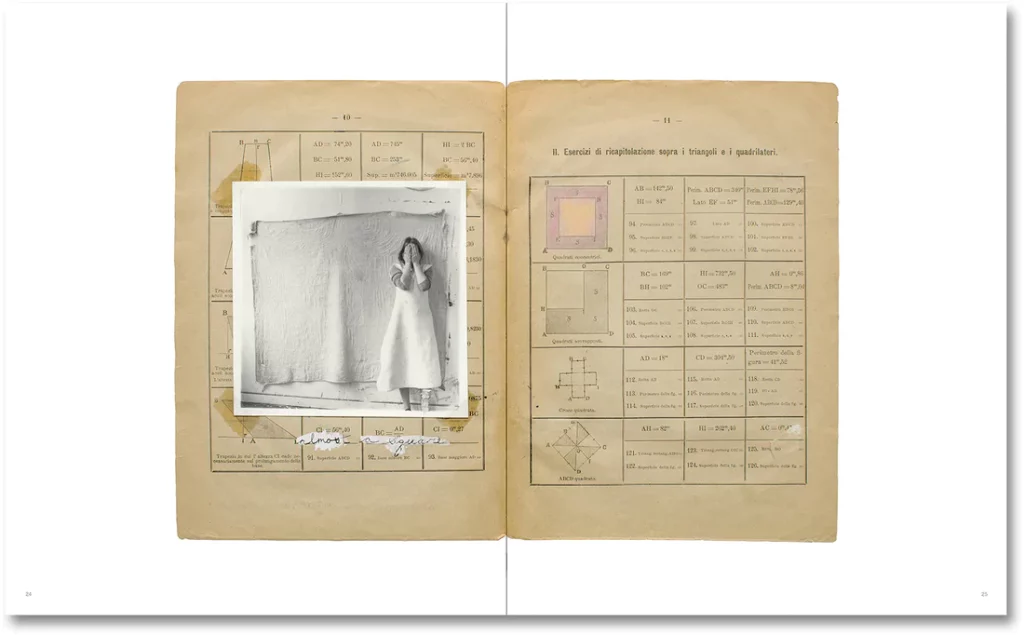
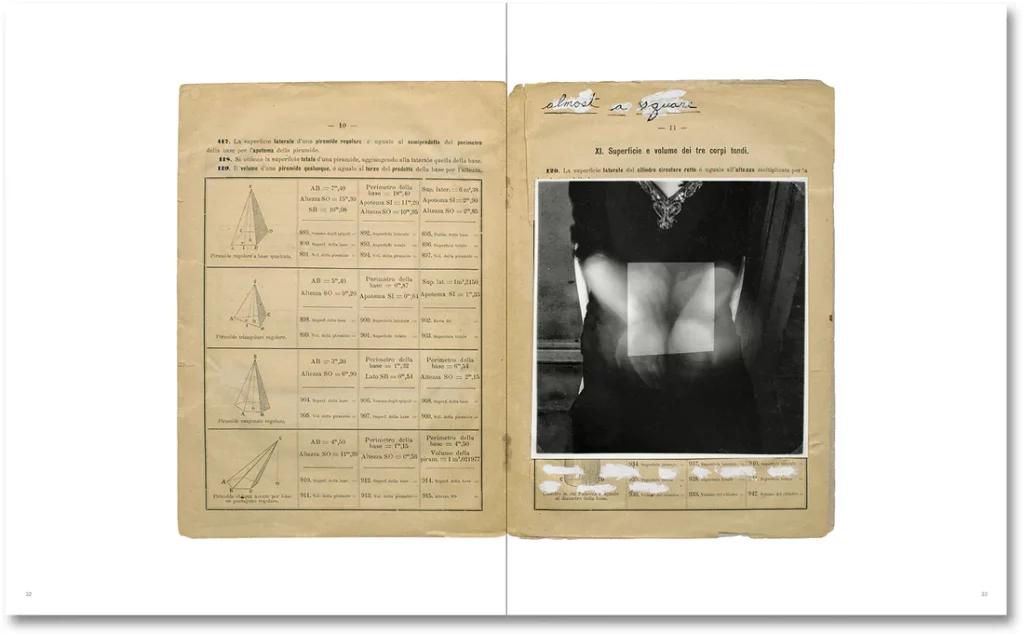
Woodman’s images are incorporated into tattered 19th and early 20th century magazines and notebooks. Woodman began collecting books and magazines in Rome in the late 1970s, for example at flea markets or in bookstores. She later edited and modified these found books and writings by inserting her prints, photographs, transparencies and notes into the volumes. Woodman linked texts, graphics and photographs to create unique sequences and sequences of images. “What I’m trying to think about is how small intimate objects or pictures in books remind one of other larger passages—proust again I guess,” reads the Woodman quote that precedes the volume. And that’s exactly what Woodman’s book is about – collages, the confrontation of one’s own photographs with the texts and graphics of others from the past. About the linking of transparent photographic foils with the translucent handwriting of some 19th-century scribe. Old postcards pasted in, new photos with handwritten notes. Mysterious portraits, body images, nudes, image details. Account books, mathematical notes.
Woodman was closely related to texts and literature: “She often mentioned what she was reading in letters to friends and family; some of her favorites included Colette, Breton, and Proust. While studying in Providence at the Rhode Island School of Design (RISD), particularly during her sophomore year (fall 1976 to spring 1977), she had already begun experimenting with literary ideas in relation to her photography. Often, she added handwritten text to the borders of her photographs, in one case inscribing a series of images with a poem she had written,” writes Katarina Jerinic, who wrote the texts in the book. And: “Woodman responded to the books’ material qualities and their found character rather than the specifics of their content. She attached her black-and-white prints to their pages, at times inserting her own text within their existing script and diagrams, and selectively obscuring portions of their content with white paint.” The connections between Woodman’s photographs and the found books, texts, notes, writings are more of a coincidental nature, what interests Woodman more is the graphically interesting thing about the books.
All eight books are, without exception, impressive, surprising, refreshing „mixed media” works: the already mentioned, originally the only published „Some Disordered Interior Geometries” from 1980, as well as „Quaderno” (1978), „Untitled (Pilgrim Mills )” (1977−1978), „Angels, Calendar Notebook” (1977−1978), „Portraits, Friends, Equations” (1977−1978), „Untitled (Self-Deceit)” (1978), and „Portrait of a Reputation” (1976−1977).
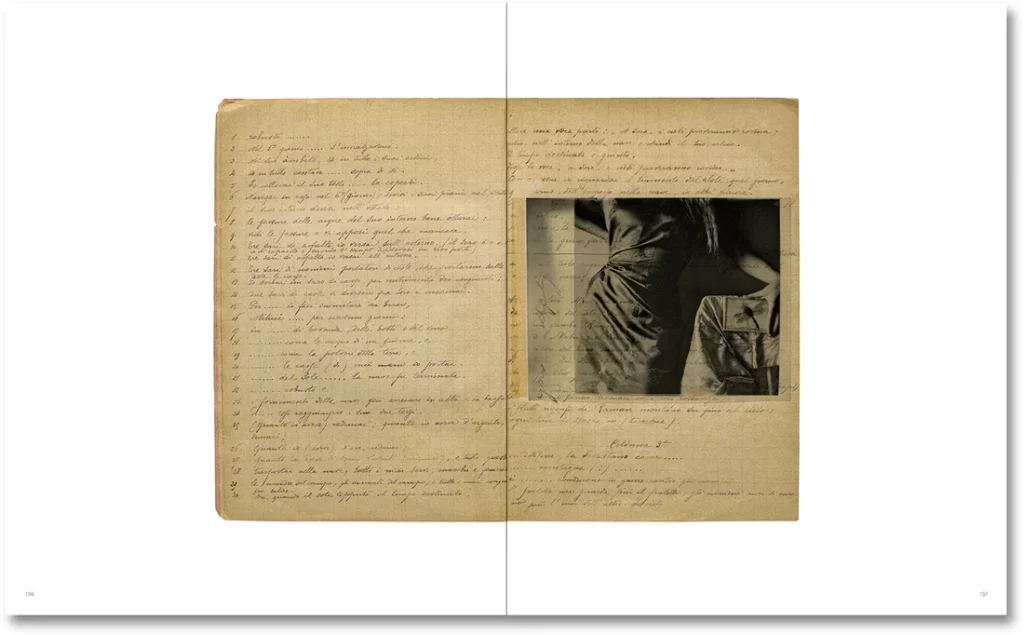
But the most impressive of the volumes for me is “Quaderno dei Dettati e dei Temi” from 1978 to 1980. Here transparent slides are glued into an early 20th-century notebook, the pages of which are densely filled with elegant cursive handwriting. The work dates from the time when Woodman had already left Rome. In December 1979 she wrote to her friend and mentor Edith Schloss: „My work is going very well. I’m making more books w/ transparent images overlaid them. I really feel like they make sense and are pretty interesting which is a nice change from that queasy feeling I feel so often. Every one says that you cant [sic] exhibit books and my kind cost to[o] much to print—but I’m nothing if not stubborn.” This artist’s book begins with self-portraits (?) in speckled dresses that beautifully reflect the speckled pattern on the book cover. Transparent image foils follow, now in front of this wonderfully beautifully curved cursive, which would perhaps make my seven-year-old son, who is about to learn cursive, green with envy. Or from a dislike of writing this way. I can’t read a bit of it, it seems Italian to me. We discover wonderfully somber portraits, blurred shots, dark fashion photos, photographed food, all in this notebook abused as an artistic photo album – in a good way. Somehow I want to get the “text genre” out. Dittato, Dictation, the headline seems to read. Vergine, virgin, I can decipher somewhere. Il dolore, amore, sonriso… pain, love, smile. A bit more support from the editors might have been helpful now, but anyway, maybe it really doesn’t matter what genre the texts come from.
In any case: MACK Books has succeeded in producing a wonderful, fascinating, comprehensive collective edition of these Woodman artists’ books, an important work in the processing of the artist’s works. It is a model for the documentation of the unpublished works, books and artist books of other photographers and artists, which is certainly still to be found in large numbers. With 416 pages, it is truly an epochal Woodman book that might have benefited from a little more text documentation. In any case, I would have liked to read and learn a lot more about what I see and examine there. Regardless, this volume is a must-read for anyone who has seen Francesca Woodman’s work – and we’ve all spent €80 on far more pointless things. Or: Anyone who has ever stood in a book printing shop and followed the production of a photo book knows that these 80 Euros are a good, fair price for such a painstakingly produced book. And anyone who tends to collect books as a store of value should even consider purchasing the collector’s edition, which is limited to 100 copies.
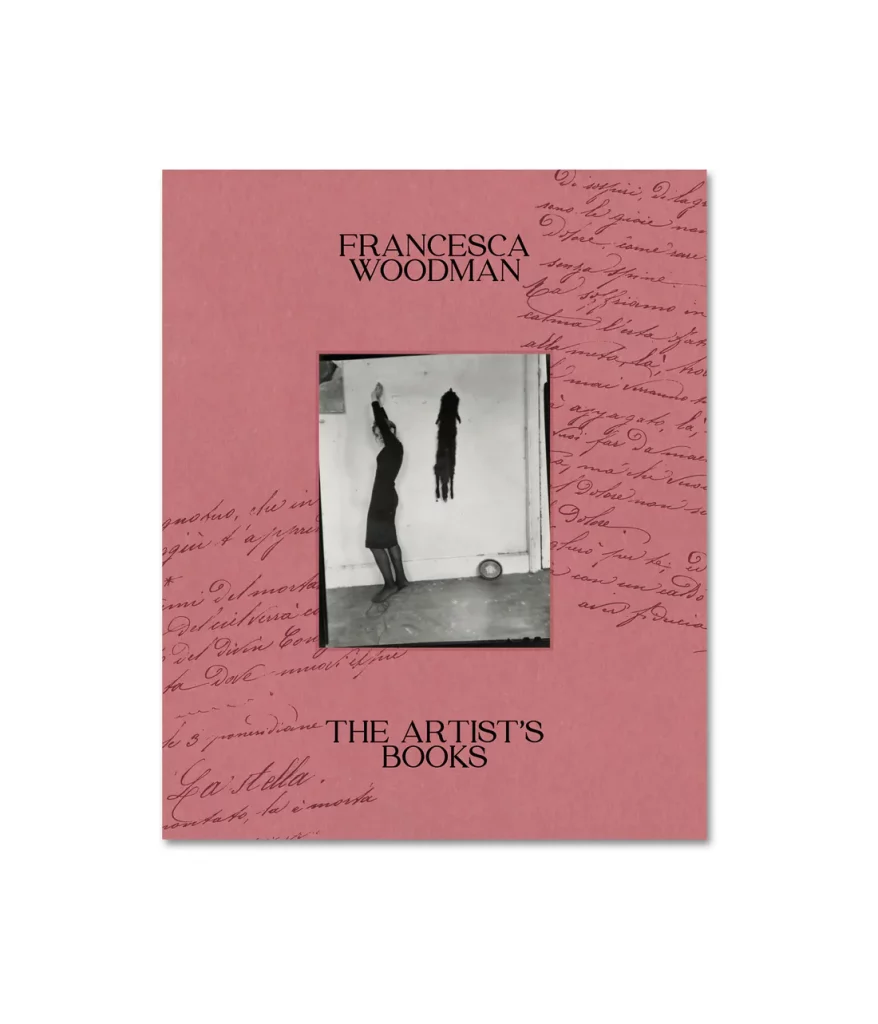
Embossed hardcover using Japanese paper, with tipped-in image
24.5 x 30 cm, 416 pages
ISBN 978−1−913620−88−2
May 2023
€80 £65 $80
https://mackbooks.eu/products/the-artist-s-books-br-francesca-woodman
GERMAN VERSION
Francesca Woodman ist eine Legende. Ich kenne ihren Namen und einige ihrer Fotos seit langem. Richtige Aufmerksamkeit erweckte ihr Werk bei mir, als bei der renommierten Berliner Fotogalerie C/O Berlin die Ausstellung „On Being an Angel“ zu sehen war. März bis September 2020, mitten in den ersten Corona-Lockdown hinein. Organisiert wurde die Ausstellung vom Stockholmer Moderna Museet.
Francesca Woodman als Legende: Nur 22 Jahre alt war sie, als sie sich an der East Side in Manhattan das Leben nahm. Noch jünger als jene lange Liste früh gestorbener KünstlerInnen, die mit 27 den Tod fanden: Hendrix, Joplin, Cobain, Morrison, Winehouse. James Dean war 24. Mit 22 hat man sich halt als KünstlerIn häufig noch nicht rechtzeitig einen Namen gemacht.
Aber wer war Francesca Woodman? 1958 wurde sie in Denver, Colorado geboren, als Jugendliche begann sie zu fotografieren. Später studierte sie an der Rhode Island School of Design, unter anderem beim berühmten Aaron Siskind, mit einem Stipendium lebte sie einige Zeit in Rom und kam dort mit Modedesignerin in Kontakt. Ihr Leben war immerhin lang genug, dass sie noch einige Einzel- und Gruppenausstellungen hatte, immerhin umfasst ihr Nachlass, verwaltet vom Estate of Francesca Woodman, rund achthundert Drucke und tausende vo Negativen. Wenige Tage vor ihrem Tod veröffentlichte sie noch ihren Bildband „Some Disordered Interior Geometries“. So richtig fanden Woodman und ihr Werk dann aber erst nach ihrem Tod Anerkennung.

Die erste große Werkschau wurde im Jahr 1986 im Wellesley College Museum in Massachusetts gezeigt. Die Ausstellung reiste im Anschluss durch etliche US-amerikanische Universitätsmuseen. Im Jahr 1992 schließlich erreicht ihr Werk erstmals Europa.
Der renommierte Londoner Fotobuchverlag MACK BOOKS hat nun Francesca Woodmans acht Künstlerbücher in einem umfangreichen Band veröffentlicht, darunter auch zwei neu entdeckte Bücher, die bisher unbekannt waren. „Some Disordered Interior Geometries“ ist aber auch in diesem Sammelband enthalten.
Woodmans Bilder sind in zerfledderte Zeitschriften und Notizbücher aus dem 19. und frühen 20. Jahrhundert eingearbeitet. Woodman begann Ende der 1970er Bücher und Zeitschriften in Rom zu sammeln, etwa auf Flohmärkten oder in Buchhandlungen. Später bearbeitete und veränderte sie diese vorgefundenen Bücher und Schriften, indem sie ihre Drucke, Fotografien, Folien und Notizen in die Bände einfügte. Woodman verknüpfte Texte, Grafiken und Fotografien und erzeugte damit einzigartige Sequenzen und Bilderabfolgen. “What I’m trying to think about is how small intimate objects or pictures in books remind one of other larger passages—proust again I guess,” lautet das Woodman-Zitat, das dem Band vorangestellt ist. Und genau darum geht es in Woodmans Buchwerk – um Collagen, um die Konfrontation der eigenen Fotografien mit den Texten und Grafiken anderer, aus der Vergangenheit. Um die Verknüpfung durchsichtiger Fotografie-Folien mit der durchscheinenden Handschrift irgendeines Schreibers aus dem 19. Jahrhundert. Alte, eingeklebte Postkarten, neue Fotos mit handschriftlichen Notizen. Geheimnisvolle Porträts, Körperbilder, Akte, Bildausschnitte. Rechnungsbücher, mathematische Notizen.
Woodman hatte einen engen Bezug zu Texten und zu Literatur: „She often mentioned what she was reading in letters to friends and family; some of her favorites included Colette, Breton, and Proust. While studying in Providence at the Rhode Island School of Design (RISD), particularly during her sophomore year (fall 1976 to spring 1977), she had already begun experimenting with literary ideas in relation to her photography. Often, she added handwritten text to the borders of her photographs, in one case inscribing a series of images with a poem she had written,“ schreibt Katarina Jerinic, die die Texte im Buch verfasst hat. Und: “Woodman responded to the books’ material qualities and their found character rather than the specifics of their content. She attached her black-and-white prints to their pages, at times inserting her own text within their existing script and diagrams, and selectively obscuring portions of their content with white paint.” Die Verbindungen zwischen Woodmans Fotografien und den vorgefundenen Büchern, Texten, Notizen, Schriften sind also eher zufälliger Natur, eher das grafisch Interessante an den Büchern ist das, was Woodman interessiert.

Alle acht Bücher sind ausnahmslos beeindruckende, überraschende, erfrischende „Mixed Media“-Werke: Das bereits erwähnte, ursprünglich als einziges veröffentlichte „Some Disordered Interior Geometries“ aus dem Jahr 1980, ebenso wie „Quaderno“ (1978), „Untitled (Pilgrim Mills)“ (1977–1978), „Angels, Calendar Notebook“ (1977–1978), „Portraits, Friends, Equations“ (1977–1978), „Untitled (Self-Deceit)“ (1978), sowie „Portrait of a Reputation“ (1976–1977).
Der beeindruckendste der Bände ist für mich aber „Quaderno dei Dettati e dei Temi“ aus den Jahren 1978 bis 1980. Durchsichtige Bildfolien sind hier in ein Notizbuch aus dem frühen 20. Jahrhundert geklebt, dessen Seiten dicht mit eleganter Schreibschrift gefüllt sind. Das Werk stammt aus der Zeit, als Woodman Rom bereits verlassen hatte. Im Dezember des Jahres 1979 schrieb sie an ihre Freundin und Mentorin Edith Schloss: „My work is going very well. I’m making more books w/ transparent images overlaid them. I really feel like they make sense and are pretty interesting which is a nice change from that queasy feeling I so often feel. Every one says that you cant [sic] exhibit books and my kind cost to[o] much to print—but I’m nothing if not stubborn.” Dieses Künstlerbuch beginnt mit Selbstporträts (?) in gefleckten Kleidern, die wunderbar das Fleckenmuster des Bucheinbandes widerspiegeln. Es folgen durchsichtige Bildfolien, nun vor dieser so wundervoll schön geschwungenen Schreibschrift, die meinen siebenjährigen Sohn, der gerade auch Schreibschrift lernen soll, vielleicht vor Neid erblassen lassen würde. Oder vor Abneigung, gegen diese Art zu schreiben. Ich kann kein bisschen davon lesen, es scheint mir Italienisch zu sein. Wir entdecken wundervoll düstere Porträts, verwischte Aufnahmen, dunkle Modefotos, fotografiertes Essen, all das in diesem zum künstlerischen Fotoalbum – im positiven Sinne – missbrauchten Notizbuch. Irgendwie will ich dann doch das „Textgenre“ herausbekommen. Dittato. Diktat, scheint die Überschrift zu lauten. Vergine, Jungfrau, kann ich irgendwo entziffern. Il dolore, amore, sonriso… Schmerz, Liebe, Lächeln. Ein bisschen mehr Unterstützung durch die HerausgeberInnen wäre jetzt vielleicht hilfreich gewesen, aber egal vielleicht ist es ja wirklich nicht wichtig, welchem Genre die Texte entspringen.
Jedenfalls: Dem MACK-Verlag ist eine wundervolle, faszinierende, umfassende Sammeledition dieser Woodmanschen Künstlerbücher gelungen, ein wichtiges Werk in der Aufarbeitung der Werke der Künstlerin. Es ist ein Vorbild für die sicher noch in großem Umfang ausstehenden Dokumentationen der unveröffentlichten Arbeiten, Buchwerke und Künstlerbücher anderer Fotografen und Künstler. Mit 416 Seiten wahrlich ein epochales Woodman-Buch, dem vielleicht ein kleines bisschen mehr Textdokumentation gutgetan hätte. Ich hätte jedenfalls gerne noch viel mehr gelesen und erfahren, über das, was ich da sehe und begutachte. Aber egal: Für jeden, der das Werk von Francesca Woodman schon einmal kennengelernt hat ist dieser Band ein Muss – und jeder von uns hat schon 80€ für weitaus sinnlosere Dinge ausgegeben. Oder: Wer schon einmal in einer Buchdruckerei gestanden hat und die Herstellung eines Fotobildbandes verfolgt hat, weiß, dass diese 80 Euro ein guter, fairer Preis für solch ein aufwändig hergestelltes Buch sind. Und wer zum Sammeln von Büchern als Wertanlagen neigt, sollte gar den Erwerb der auf 100 Exemplare begrenzten Sammlerausgabe erwägen.
–
Vorbestellbar – dieser Titel soll im April 2023 erscheinen.
Sonderausgabe erhältlich
Geprägtes Hardcover aus japanischem Papier, mit eingelegtem Bild
24,5 x 30 cm, 416 Seiten
ISBN 978−1−913620−88−2
Mai 2023
80 € 65 £ 80 $
https://mackbooks.eu/products/the-artist-s-books-br-francesca-woodman